
Google Ads With My Own Money at Risk
Advertising feels different when the budget is yours.
Long before positioning Yoosten as a specialist Google Ads management service, I was using paid search to build and monetize my own online properties.
A large part of that work has been affiliate advertising: building websites around products and services, buying traffic with Google Ads, and earning a commission when that traffic turns into business for the advertiser.
The important difference is simple: the advertising spend was my own money. If a campaign lost money, I absorbed the loss personally.
A narrower margin for error.
Affiliate advertising can be less forgiving than advertising for the company actually selling the product.
The underlying advertiser receives the full value of the customer it acquires. As an affiliate, I receive only an agreed portion of that value — while still competing in the same Google Ads auctions and paying market prices for the traffic.
That creates a much thinner margin between the cost of acquiring traffic and what that traffic can ultimately earn.
A long operating history, not a short experiment.
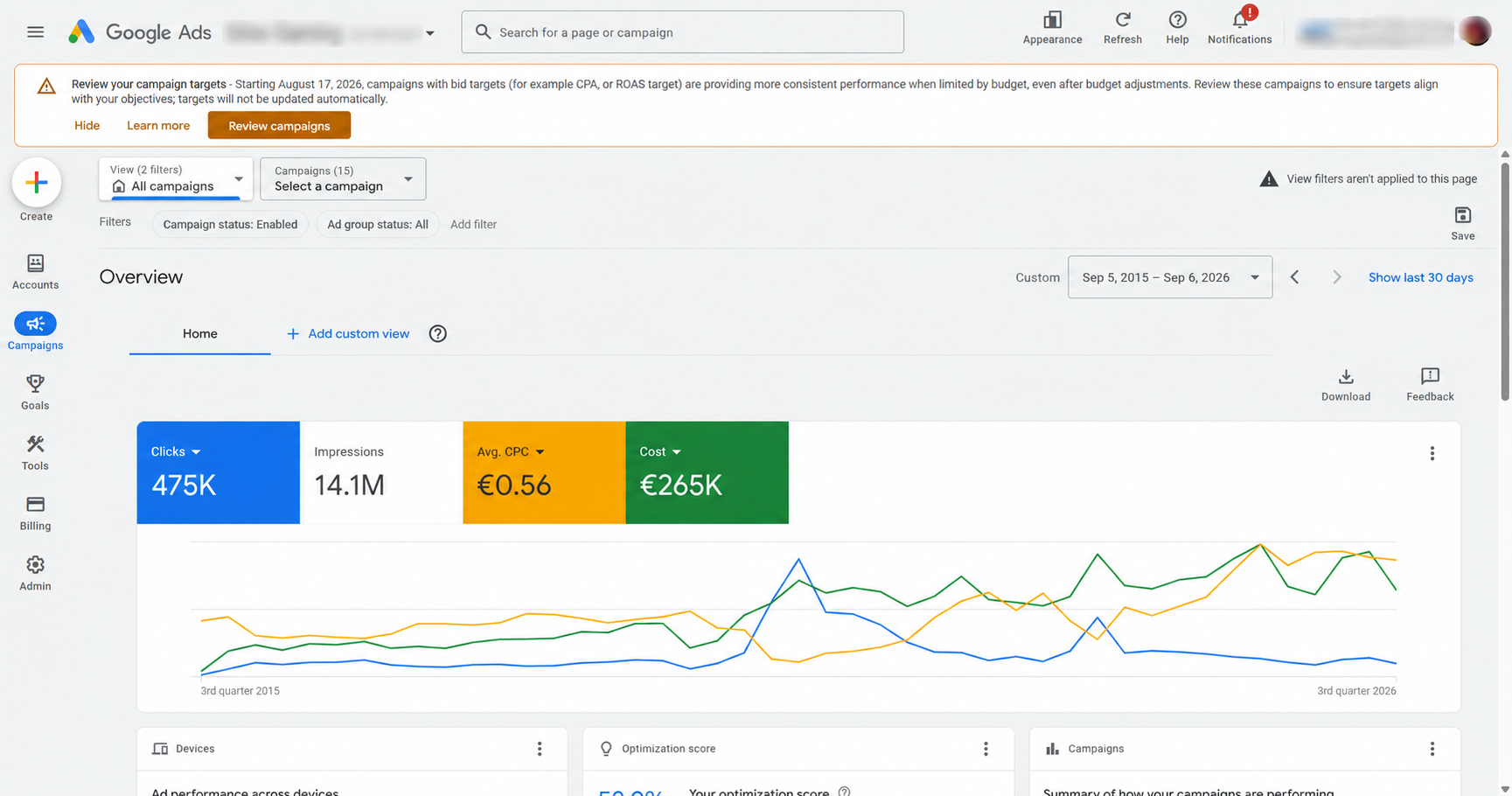
The figures shown here come from years of real Google Ads activity across my own affiliate projects rather than a temporary test account or isolated campaign.
More than buying cheap clicks.
Running affiliate campaigns requires looking beyond the Google Ads interface. The advertising is only one part of the commercial equation.
Different products, different economics.
I have used Google Ads to promote products and services across categories including software, ecommerce tools, password management, email marketing, business services and other online products.
Search behavior changes. CPCs change. Commission structures change. Conversion rates change. The underlying discipline does not: understand what a conversion is worth, what you can afford to pay for it, and whether the investment makes sense.
Not every campaign worked.
Some campaigns developed into profitable, long-running projects. Others did not.
Sometimes the market is too expensive, the economics of the offer are too weak, or the conversion rate simply cannot support the cost of acquiring the traffic.
Knowing when to stop spending is part of good advertising management.
Client responsibility and personal risk.
I look at the account from the business side.
Google Ads specialists naturally spend a lot of time looking at campaigns, keywords, bidding strategies, conversion actions and account structure.
Those things matter, but they are not the end goal. A business is putting capital into an acquisition channel and expecting something commercially valuable back.
Running my own websites and funding my own advertising has made that perspective difficult to forget.
What can we afford to pay to acquire one?
Where is money being wasted?
Where does spending more make economic sense?
What this changes in the way I manage Google Ads.
Client accounts should not simply be managed like affiliate campaigns. Businesses can have very different margins, repeat-purchase behavior, lifetime values and strategic reasons for acquiring customers.
What carries over is the discipline. I care about wasted traffic, what happens after the click, and whether the spend can be connected to a sensible commercial objective.
And when the economics are working, the goal is not necessarily to spend less. It is to put more capital behind the areas where the expected return makes doing so worthwhile.
The affiliate campaigns described on this page promoted third-party products and services through affiliate relationships. References to those campaigns do not mean that the underlying brands retained Yoosten for Google Ads management. Advertising spend shown here was funded as part of my own affiliate marketing activity.