Case Study
Long-term Google Ads management for an established online licensing business.
A live account I have managed since 2022, with campaigns separated around different types of search intent, acquisition strategy and commercial value.
Industry:
Online licensing
•
Client since:
2022
•
Results shown:
June–August 2026
Results Snapshot
Three months of live Google Ads performance.
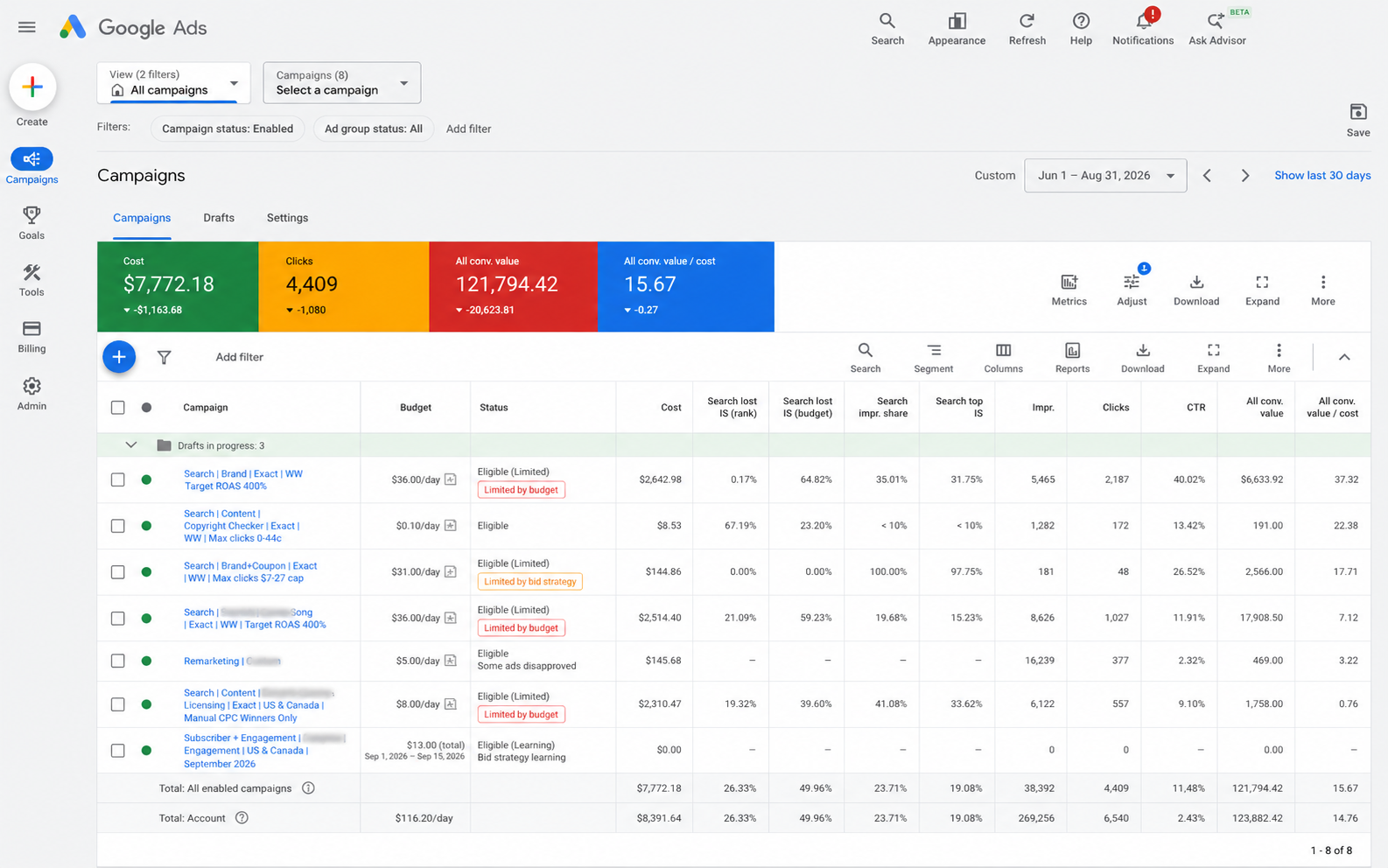
From June 1 through August 31, 2026, the enabled campaigns generated the following results inside Google Ads.
$7,772.18
Google Ads spend
$121,794.42
Google Ads all conversion value
15.67
All conversion value / cost
Conversion value is the value reported by Google Ads according to the client’s conversion-tracking configuration. It is shown as a Google Ads performance metric rather than independently audited revenue.
Account Evidence
The underlying campaign data.
This is a screenshot from the live Google Ads account covering the same June–August 2026 period. Identifying campaign information has been obscured where necessary for client confidentiality.

What The Data Shows
Strong overall numbers can hide very different campaign economics.
The account produced a 15.67 reported conversion-value-to-cost ratio across enabled campaigns during the period shown. But the individual campaigns did not all perform equally.
Different intent produces different results.
Some campaigns generated substantially more reported value relative to spend than others. Looking only at the account-wide average would hide those differences.
Budget is not treated equally.
Campaigns can be managed independently according to their search intent, commercial role and observed performance rather than simply expanding wherever Google can generate more traffic.
Performance needs context.
Brand demand, higher-intent searches, remarketing and more exploratory acquisition can have very different economics. The job is to understand those differences before deciding where additional budget belongs.
A Documented Management Decision
Cutting reach that was no longer earning its place.
One example came in September 2025. Parts of the account were generating very large amounts of reach through YouTube engagement campaigns, while the broader acquisition strategy was increasingly being concentrated around traffic with clearer commercial intent.
On September 3–4, several of those engagement campaigns were paused. The objective was not to preserve impressive-looking impression volume. It was to reduce spend on activity that was less central to measurable customer acquisition and keep more of the account focused on commercially useful traffic.
Before
$3,595
Google Ads spend in August 2025
After
$1,860
Google Ads spend in September 2025
~85% lower daily impression volume
The immediate drop followed the September 3–4 campaign changes and remained substantially lower rather than rebounding after a few days.
What happened over the longer term?
The subsequent account data shows the same broader direction: less exposure did not mean fewer recorded outcomes.
−34.5%
Impressions, Jan–Aug 2026 vs. Jan–Aug 2025
+10.4%
Recorded conversions, Jan–Aug 2026 vs. Jan–Aug 2025
Across those comparable eight-month periods, impressions fell from approximately 35,636 to 23,346, while recorded Google Ads conversions increased from approximately 684 to 755.
The comparison above describes the observed account-level trend. Advertising performance is affected by multiple factors, so the September 2025 campaign changes should not be interpreted as the sole cause of all subsequent performance.
Management Approach
Manage toward business value, not activity.
The account is divided across campaigns with different purposes so that bids, budgets and targeting can be managed according to what each part of the account is actually trying to accomplish.
Search intent.
Search terms and keywords are reviewed to understand what users are actually looking for before budget is expanded.
Campaign economics.
Spend and reported conversion value are evaluated at campaign level rather than relying only on an attractive account-wide average.
Budget allocation.
Stronger and weaker parts of the account can be treated differently as performance and business priorities change.
Landing-page alignment.
Where useful, high-intent searches are directed toward pages that closely match the service or action the visitor is looking for.
Long-Term Management
Managed continuously since 2022.
This is not a one-time audit or an account rebuilt for a case study. I have managed the client’s Google Ads over multiple years as campaigns, budgets, products and acquisition priorities have changed.
That long-term relationship also means the objective is not to manufacture short-term improvements for a report. The account has to continue making commercial sense after the initial optimizations are finished.
The Takeaway
The biggest number is not necessarily the best result.
The account has at times generated substantial reach, traffic and reported conversion value. The more important question is whether each part of that activity deserves the money being spent on it.
The September 2025 changes are one concrete example: removing large amounts of low-priority reach substantially reduced impression volume and spend, while the account subsequently produced more recorded conversions with fewer impressions across comparable 2025 and 2026 periods.
That is the level at which I prefer to manage Google Ads accounts: not optimizing for activity, but deciding which activity is commercially worth keeping.
Client Confidentiality
The client is intentionally not identified. Certain campaign names and account information have been obscured to protect commercially sensitive information. The performance figures shown above are taken from the Google Ads account for the stated periods.
Your Account
Want to talk through your Google Ads account?
If you’re already spending at least $4,000 per month, book a short call and tell me what you’re seeing in the account, what’s working and what you’d like to improve.
Book a 20-Minute Google Ads Call
Google Meet • Talk directly with Hendrik • No sales pitch